Takeaways from this article4 points
Mark the spot and call 112
If you hit an elk, roe deer, wild boar or another animal listed in the Hunting Ordinance, mark the spot and call 112.
Even when the animal is dead
The strip must go up even if the animal lies dead. It shows other road users that the accident has been reported.
The right place saves suffering
Give the police the road number, place and a landmark, or use the 112 app. A wrong location leaves an injured animal waiting.
Strips in every vehicle
The duty lies with the driver, but the company can keep wildlife accident strips in every vehicle and brief its drivers.
The animals covered
The duty is set out in Section 40 of the Hunting Ordinance (jaktförordningen, 1987:905) and covers bear, wolf, wolverine, lynx, elk, deer, roe deer, otter, wild boar, mouflon and eagle. Deer here means both red deer and fallow deer. It is the driver who must mark the site of the accident and inform the police, as soon as possible.
If you hit any other wild animal, there is no formal duty to report it to the police.
Wildlife collisions are common. The Swedish Transport Administration (Trafikverket) counted 73,300 on the roads in 2025, including collisions with reindeer, an average of 201 a day. It estimates that the real number is higher.
What to do at the scene
Put out the warning triangle so that no one else drives into the accident.
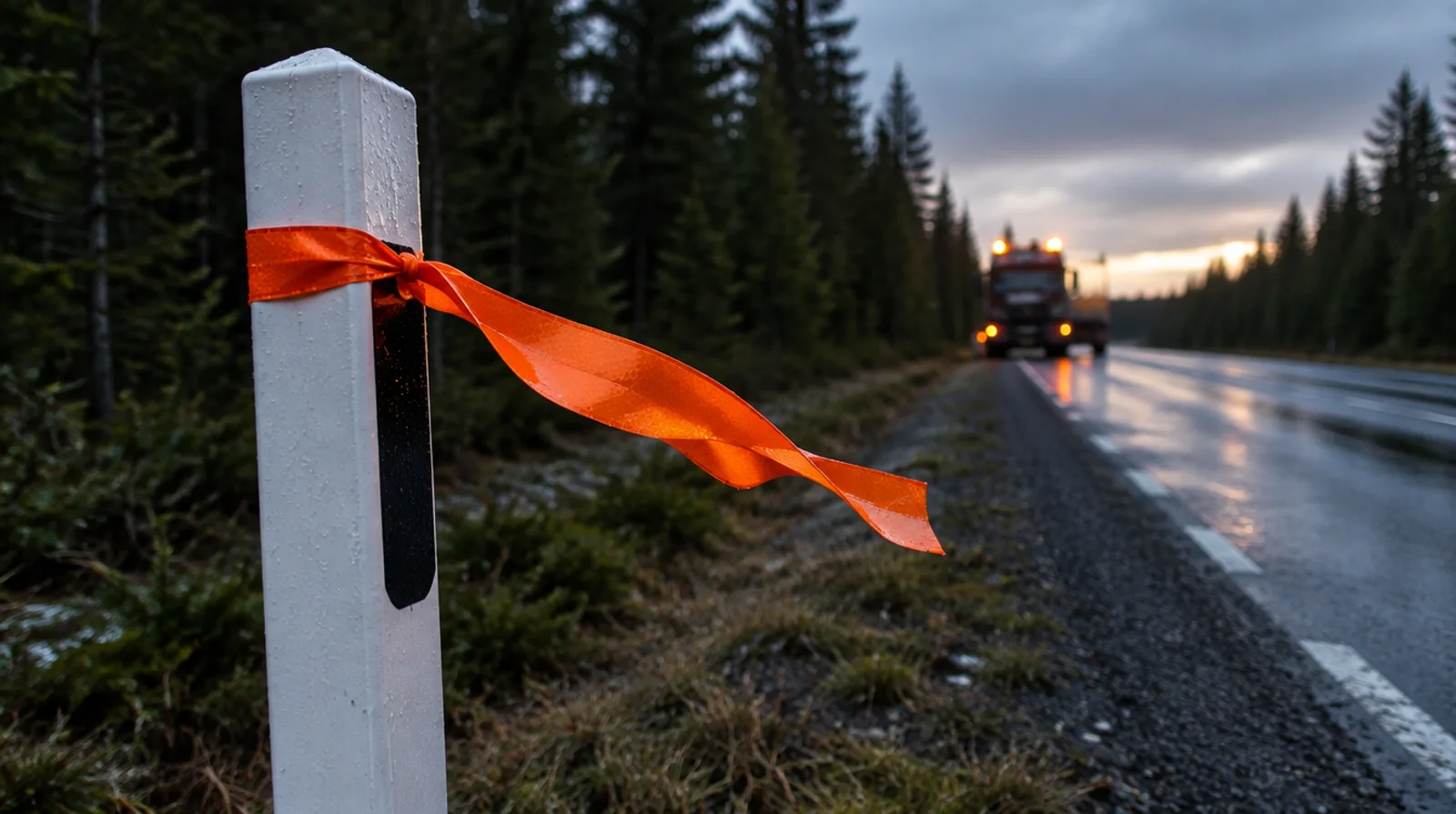
Mark the spot with a wildlife accident strip (viltolycksremsa), or with something else that can be seen if you have none, such as a plastic bag. Hang it on the side of the road where the animal disappeared. If you hit a wild boar, bear, wolf or lynx, place the strip about 100 metres from the accident site and tell the police. Mark the spot even if the animal lies dead. The strip shows other road users that the accident has already been reported.
Call 112 and report the accident. If a dead animal lies on the road you can move it if possible, but think of your own safety. Do not search for an injured animal yourself, and do not try to put it down unless you know how. The animal's suffering can get worse.
What the police want to know
Where the accident happened: road number, place and a landmark. SOS Alarm's 112 app sends a GPS position. Otherwise, reset the trip meter, drive to a place you recognise, such as a junction or a lay-by, and read off the distance.
The police also want to know how you marked the spot, what kind of animal it was, whether there was one or more, and which way it ran. A wrong location is common, according to Nationella viltolycksrådet, the national council for wildlife accidents, and often means that an injured animal lies suffering for a long time.
What happens next
The 112 call is put through to the police regional command centre. There, a map shows which of Nationella viltolycksrådet's contact people is responsible for that stretch of road, and the contact person makes sure a tracking hunter comes out. The Hunting Ordinance gives the police the right to ask someone else to track the animal.
Make sure you can be reached by phone afterwards. The tracking hunter may need to call you to find the right place.
How the tracking works and who gets the animal afterwards is explained by Jaktkursen in its guide to wildlife collisions (in Swedish).
For hauliers, bus and taxi companies
The duty lies with the person driving, so for an employed driver it is the driver who must mark the spot and call. The company can make it easy: keep wildlife accident strips in every vehicle and make sure all drivers know what to do.
The strips are free. A company that needs up to 200 collects a box at a police reception, and anyone who needs more emails Nationella viltolycksrådet and gets them delivered free of charge. Single strips are available at police stations, vehicle inspection stations and Trafikverket's driving test offices.
Sources
- Jaktförordningen (1987:905) 40 § (Hunting Ordinance, Section 40)
- Nationella viltolycksrådet: Så här gör du om du kolliderar med vilt
- Nationella viltolycksrådet: Eftersök av trafikskadat vilt
- Nationella viltolycksrådet: Skaffa viltolycksremsor
- Trafikverket: Viltolyckor, barriärer och säkra passager för djur